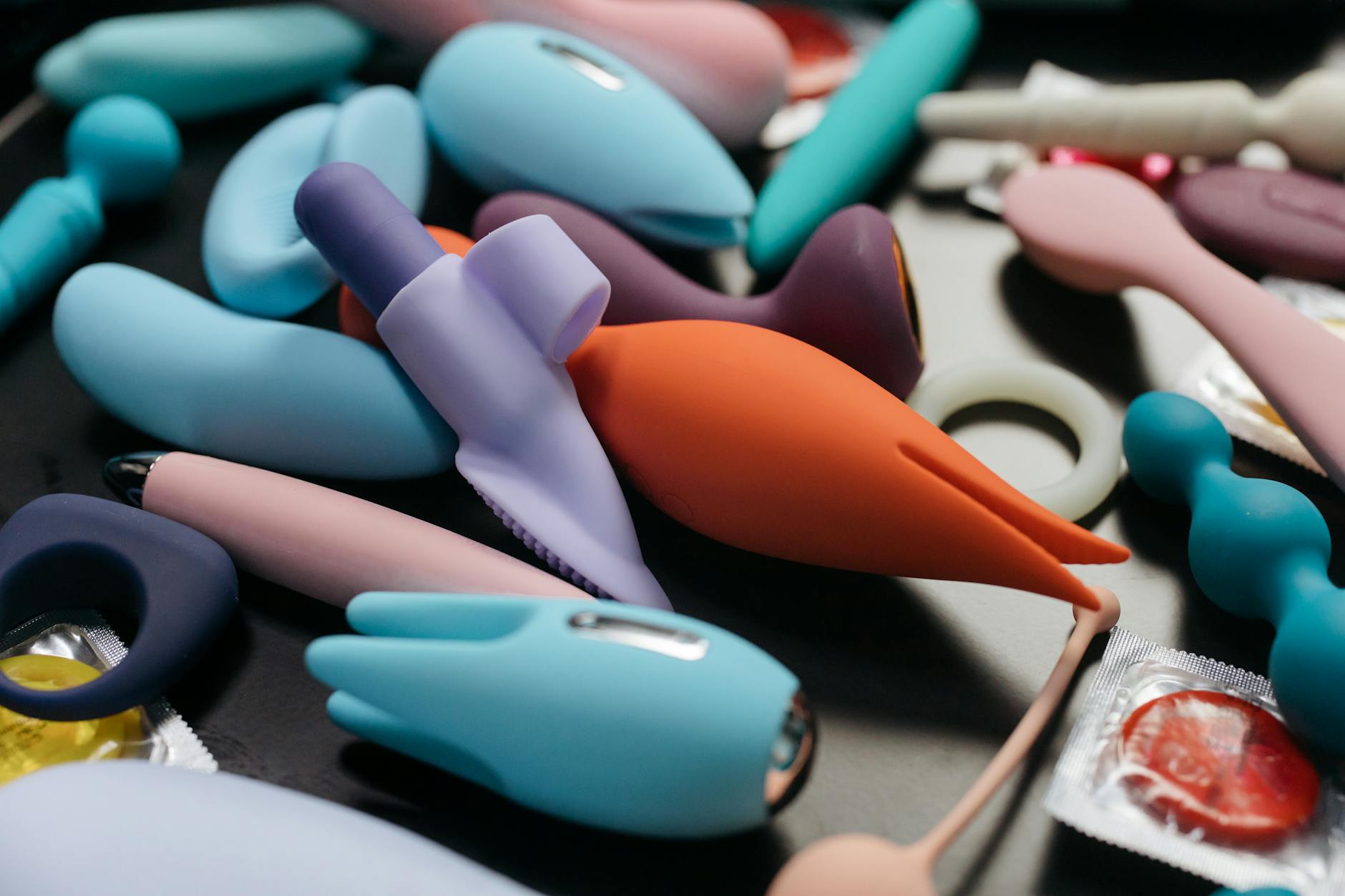
Hormones don't just affect how you feel emotionally. They reshape your physical response to touch, how quickly you get wet, how sensitive your clitoris is, and what kind of stimulation feels good on any given day. Most people never talk about this because there's no language for it. So we pretend our body stays the same all month, and then get frustrated when pleasure doesn't.
Estrogen peaks right before ovulation. During this window (roughly days 8-14 of a typical 28-day cycle), tissue gets thicker, blood flow to the genitals increases, and your clitoris becomes more sensitive. Orgasms tend to arrive faster. This is when many people feel the strongest urge to have sex.
Then progesterone takes over after ovulation. It's a downer hormone. Blood flow to the genitals decreases slightly, sensation becomes more diffuse, and arousal takes longer to build. Your body is prioritizing other things. This is not weakness. It's your nervous system doing its job.
During menstruation, estrogen and progesterone both drop. Sensitivity varies wildly person to person. Some people report heightened sensation and easier orgasms during their period. Others feel numbed or need different kinds of touch. There is no "normal" here. Your job is to notice your own pattern.
The suction-based design of lemon clitoral vibrators like The Lem creates consistent, broad stimulation that doesn't depend on sustained tissue sensitivity the way direct vibration does. During low-hormone phases, when your tissue is thinner or sensation feels distant, suction triggers deeper nerve engagement without requiring micro-adjustments.
Translate: if your vibrator usually feels perfect but suddenly feels too intense or too shallow, your hormones shifted. A lemon clitoral vibrator adapts better to that shift than a traditional vibrator because you're not fighting friction against sensitive tissue. The suction does the work for you.
Also, The Lem has multiple intensity levels. This matters more than people realize. During high-hormone phases, you might start at level 5 and barely feel it. During low phases, level 2 is perfect. Having that range means you're not replacing your toy every few weeks because "it stopped working."
Right before ovulation, give yourself permission to want more.
Increase intensity. Start at a higher setting than usual. Your tissue can handle it, and your nervous system is primed for stimulation.
Shorten warm-up time. You might orgasm in 5-7 minutes instead of 15. That's not rushing. That's your body responding the way it's designed to during this window.
Experiment with rhythm. The follicular phase (before ovulation) is when novelty feels great. Try switching between suction levels mid-session. Try different positioning. Your clitoris is literally more accessible during this phase because of swelling.
Use less lubricant, or none. Your body is producing its own. Adding commercial lube might actually feel uncomfortable because you're already well-lubricated. Trust that.
After ovulation, your body needs different things.
Lower the intensity and accept that. This is not your vibrator getting weak. This is you becoming more subtle, and subtlety can be just as satisfying. Start at level 1 or 2 and let it build slowly.
Budget more time. Give yourself 20-30 minutes instead of 10. Your arousal is like a dimmer switch now instead of an on-off button. That slowness is not a problem to solve. It's information about what your body needs.
Add lubrication. Even if you usually don't need it, progesterone reduces natural lubrication. Water-based lube on top of your own wetness feels completely different from either alone. This changes the sensation in a good way.
Change your positioning. Higher hormone phases often feel good lying on your back. Lower phases sometimes feel better sitting up or side-lying, where you have more control and can adjust pressure.
Some days you'll orgasm easily. Other days, the same toy at the same intensity will feel meh. There's no hack for this except observation. Menstrual fluid changes the sensation of suction slightly. Uterine contractions during orgasm can feel different. Some people love this. Others prefer to skip pleasure play during their period.
If you do use your lemon vibrator during menstruation, wash it thoroughly after. Blood can harbor bacteria, and you want to protect both your toy and your body.
One thing I consistently hear: some people report their strongest orgasms of the month during their period, especially the first 2-3 days. If that's you, lean into it. Don't let anyone's idea of "appropriate" override your own pleasure.
Your hormones don't just shift monthly. They shift across decades.
Many people notice changes in the 5-10 years before menopause (perimenopause). Tissue gets slightly thinner, lubrication decreases, and sensitivity fluctuates wildly week to week. This is when you might suddenly realize your favorite toy feels different. A lemon clitoral vibrator is particularly useful here because you can dial intensity down without losing effectiveness.
If you're on hormonal birth control, you've already disrupted your natural cycle. The pill, the ring, the patch, and the IUD all suppress or alter hormone fluctuations. This means sensation stays more stable month to month, but it also means you might have less intense arousal overall. Some people love this flatness. Others miss the peaks and valleys.
If you're on antidepressants or other medications that affect hormones or neurotransmitters, pleasure can flatten or become harder to access. A lemon vibrator with multiple intensity levels gives you options. Sometimes lower intensity actually works better when medication is reducing natural arousal. Sometimes you need to give yourself more time. Your toy should flex with that, not fight it.
Here's what I recommend to clients: use a period tracker app, and start adding a one-word note about pleasure.
"Easy." "Numb." "Intense." "Slow."
After 2-3 cycles, patterns emerge. You'll know that days 10-14 feel electric and day 22 feels thick. You'll know that during your period, suction feels better than vibration. You'll know that five days after ovulation, you need lube even though you usually don't.
This information is gold. It transforms pleasure from something you do and hope for into something you actively design. And that matters for your relationship with your own body.
If your sensation changes dramatically and stays changed for more than a few cycles, worth checking in with a doctor. Sometimes hormonal shifts signal thyroid problems, hormonal imbalances, or medication interactions. Sometimes they signal nothing except "your body changed and that's normal." But it's worth knowing.
Similarly, if a certain phase of your cycle suddenly becomes painful (not just less pleasurable, but actually painful), that's worth mentioning to a healthcare provider. Pain during pleasure is different from lack of sensation, and it deserves attention.
Your lemon clitoral vibrator is not a one-setting toy. You are not a one-setting body. The pleasure you have access to changes throughout your month and across your life. That's not a limitation. That's information. Once you decode your own pattern, you stop fighting your hormones and start designing around them. Your The Lem goes with you through all of it.
Hormonal numbness is cyclical and predictable once you track it. It shows up at the same time each month, and it resolves when your hormone levels shift again. If sensation loss is random, constant, or getting worse over months, that's worth mentioning to a doctor. It could be medication, circulation, nerve issues, or emotional stuff. Hormones are one piece of the puzzle, not the whole thing.
Yes. Wash it thoroughly before and after. Many people report that suction-based stimulation feels better during menstruation than direct vibration because the sensation is less sharp. Some people skip pleasure play entirely during their period, and that's equally fine. Your body, your call.
Yes, usually. Hormonal contraception suppresses the hormone fluctuations that drive monthly sensation changes. Most people on the pill notice pleasure feels flatter and more consistent month to month. Some prefer this. Others miss the peaks. A lemon vibrator's variable intensity helps here because you can adjust for reduced natural arousal without replacing the toy.
Not unless you want to. During peak estrogen, your body's own lubrication is usually enough. Adding more can actually feel uncomfortable or dull sensation. Trust your body. If you feel like you need more slip, add it. If you don't, don't.
Start at level 1 or 2 and work up. Everyone's sensitivity is different, and it changes across your cycle. The fact that your lemon vibrator has multiple levels means you get to experiment. What feels weak at day 10 might feel perfect at day 25. There's no "right" level, just the level that works that day.
Absolutely. Cortisol (your stress hormone) directly suppresses arousal, lubrication, and sensation. So you might be in your high-hormone phase on paper, but if you're stressed, you feel numb. This is frustrating, but it's real. The fix is not a better vibrator. It's actually addressing the stress, or at least acknowledging that today is a "use more lube and take longer" day. Your lemon vibrator adapts to both your hormones and your nervous system state.
Your hormones are not your enemy. They're information. The more you understand your own cycle and how it reshapes sensation, the better you can use tools like The Lem to meet yourself where you actually are, not where you think you should be. That's where real pleasure starts.